 PLCU India
Selling PLCU, converting the proceeds and receiving rupees are separate transactions. A wallet valuation or completed crypto trade does not prove that an INR bank payout is available. Plan the entire exit before transferring coins to a venue.
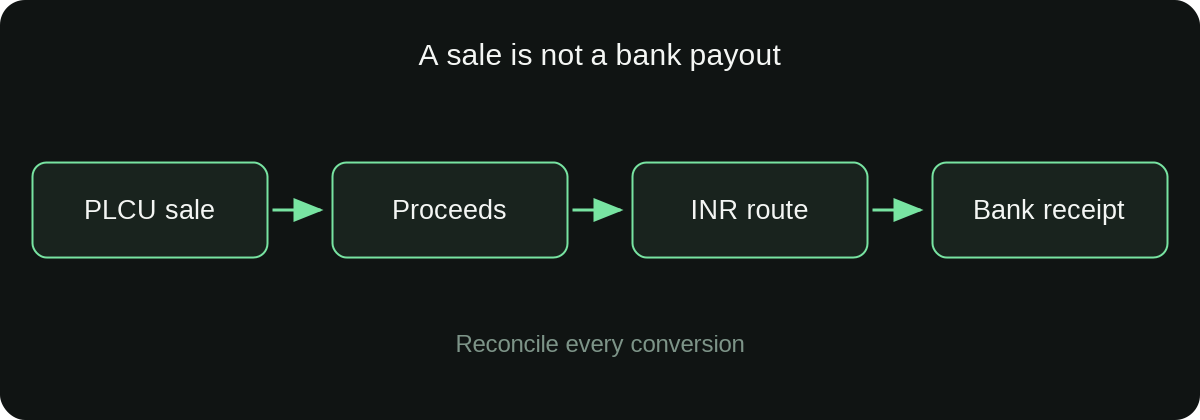
Map the exit from the coin you actually hold
Identify whether your balance is PLCU, PLCUC or a product entitlement that has not become transferable coins. Establish the chain and whether the coins can currently leave the wallet or product. A dashboard balance may require a different process from an ordinary wallet transfer.
Next, verify an eligible venue that accepts that exact asset, permits deposits and has a functioning market. Then verify how the sale proceeds can reach an INR payment route. If any link is missing, the exit is incomplete; an optimistic conversion calculator cannot supply it.
Use the asset identity guide if your balance dates from an earlier product or migration. A sale cannot be planned accurately while the asset itself remains uncertain.
Estimate proceeds from bids rather than your portfolio display
For a proposed sale, inspect the buying side of the order book. The top bid may cover only a fraction of your holding. Estimate the weighted proceeds across the levels required for the quantity, then deduct fees and later conversion costs.
As a hypothetical calculation, suppose a sale produces 100 USDT before a 1 USDT trading charge and a further 2 USDT transfer charge. Only 97 USDT reaches the next stage, before any INR conversion spread or tax consequences. These are invented inputs for arithmetic, not PLCU fees or market data.
This worksheet helps reveal which cost is important. A low network fee is irrelevant if the coin cannot be deposited, while a favourable last price is irrelevant if no buyer can absorb your intended sale. Do not call an estimate a guaranteed withdrawal amount.
Deposit only after confirming the receiving service
Read the deposit network, minimum amount and service status directly in the receiving account. Confirm whether any additional identifier is required. Do not send a different version of the coin because the venue displays a familiar logo.
Keep the sending transaction ID and watch both the chain and the exchange credit. A confirmed transfer can still await the venue's confirmation policy or review. Repeatedly sending more coins is not a way to make the first deposit appear.
An old listing is not sufficient. For example, EXMO's 2024 notice documented the end of PLCU and PLCUC services there. Saved addresses and historical tutorials should not override current instructions.
Execute the sale and identify what you now own
Before confirming, check the asset pair, quantity and order type. After execution, examine fills and the resulting balance. Selling into USDT gives you USDT, not bank rupees. A remaining open order can also leave part of your holding unsold.
If using a second platform for INR conversion, verify its eligibility, supported asset and network before withdrawing the proceeds. Do not assume a platform that accepts one version of a stablecoin accepts every network carrying that ticker.
Retain records of each conversion. A crypto-to-crypto trade may be relevant to Indian tax reporting even when no money has reached your bank. The tax guide explains why cash withdrawal date should not be used as the only tax-record date.
Separate direct bank withdrawal from P2P payment
A platform-supported INR withdrawal and a P2P buyer's bank transfer are different arrangements. In a P2P sale, the counterparty pays through the order's supported payment method; it is not necessarily an INR balance paid out by the exchange itself.
Binance's P2P selling instructions require checking actual receipt before releasing crypto. A screenshot, text message or claim that funds will arrive after release is not equivalent to a credit verified in your banking account.
If Binance is the final conversion platform, verify the eligible asset and available route independently. This guide does not claim that PLCU itself can be deposited or sold there. The Binance listing explanation covers that distinction.
Bank evidence is part of the exit
Save the order ID, counterparty information available within the service, payment reference, amount and bank credit. Keep the sale record linked to the original acquisition and crypto transfers. This helps answer a bank's source-of-funds enquiry without reconstructing events from memory.
Do not accept an unexplained third-party payment or move the discussion to a private group to obtain a better rate. If an account is restricted or a payment is disputed, use the bank's and platform's official procedures. Do not split transactions to evade checks or invent payment descriptions.
A completed P2P order does not guarantee that every later banking question disappears. Preserve evidence and respond factually. Neither an escrow mechanism nor a verified-name badge eliminates all risks involving payment origin or subsequent investigations.
Keep any legitimate refunds or returned deposits linked to the original transaction so that they are not mistaken for unrelated income.
If the route is unavailable
Do not pay a separate “liquidity activation” or “tax clearance” charge to a person claiming they can unlock your sale. Legitimate fees and obligations should have an identifiable basis and payment process, not just a chat demand.
If a market is unavailable, document the state and consider the options that genuinely exist. A limit order cannot create buyers, and a private promise is not a substitute for verified liquidity. Pausing the sale plan may be more rational than adding new risks under time pressure.
Frequently asked questions
How do I reconcile a sale completed through several fills?
Keep each fill or the provider's detailed export, including quantities, prices and fees. Add the proceeds consistently rather than multiplying the entire position by the last fill price.
What if the receiving bank asks why the payment arrived?
Provide a factual explanation supported by the relevant order and transaction records. Do not invent a sale description or accept a counterparty's instruction to conceal the actual purpose.
Should I count an unsold residual balance as bank proceeds?
No. Keep the residual asset separately and identify any minimum that prevents further sale. A small remaining balance is not equivalent to additional INR already credited to your account.